
The Essential Core Technology for Future High-Performance Solutions
Download NOW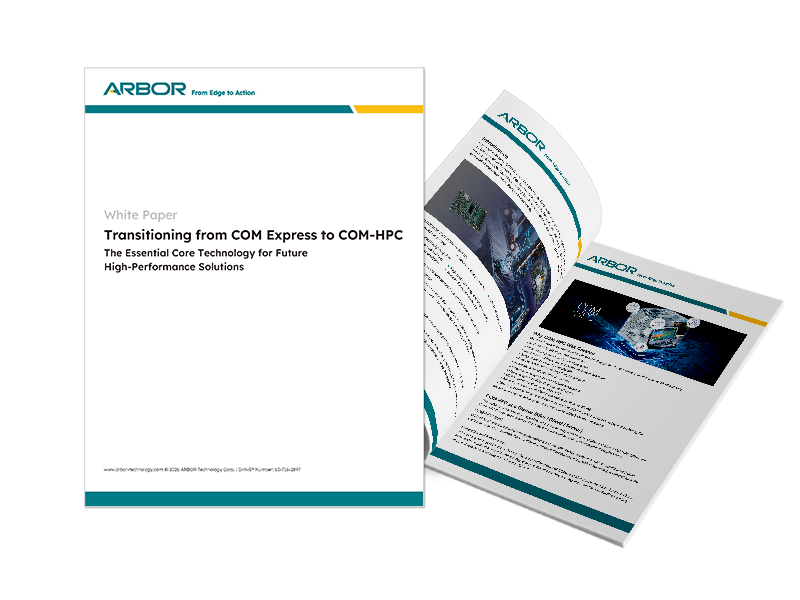
For over a decade, COM Express has been the de facto standard for modular embedded computing. However, modern workloads shift toward AI inference, real-time analytics, and high-resolution video processing, exposing architectural limits in I/O and memory bandwidth.
This white paper provides a technical deep dive into the COM Express vs COM-HPC transition. We explore how COM-HPC overcomes bandwidth saturation by leveraging PCIe Gen5 and DDR5 architectures. We analyze the diverse form factors—from Mini to Client and Server sizes—and showcase how the ARBOR COMX-A300 serves as a strategic successor.
| Form Factor | Mini | Client | Server | |||
|---|---|---|---|---|---|---|
| Size Class | - | Size A | Size B | Size C | Size D | Size E |
| Dimensions | 95 x 70 mm | 120 x 95 mm | 120 x 120 mm | 160 x 120 mm | 160 x 160 mm | 200 x 160 mm |
| Connector Pins | 400 Pins | 800 Pins (Client Interface) | 800 Pins (Server Interface) | |||
| Max Power | Up to 76W | Up to 251W | Up to 358W | |||
| PCIe Lanes | Up to 16x PCIe | Up to 49x PCIe Gen5 | Up to 65x PCIe Gen5 | |||
| Networking | 1x 10GbE | 2x 25GbE KR / 2x NBaseT | Up to 8x 25GbE KR | |||
High-performance CPUs like COM-HPC require advanced cooling strategies to avoid throttling.
Read our Thermal Solutions White Paper »Fill out the form below to receive the "Transitioning from COM Express to COM-HPC" white paper.